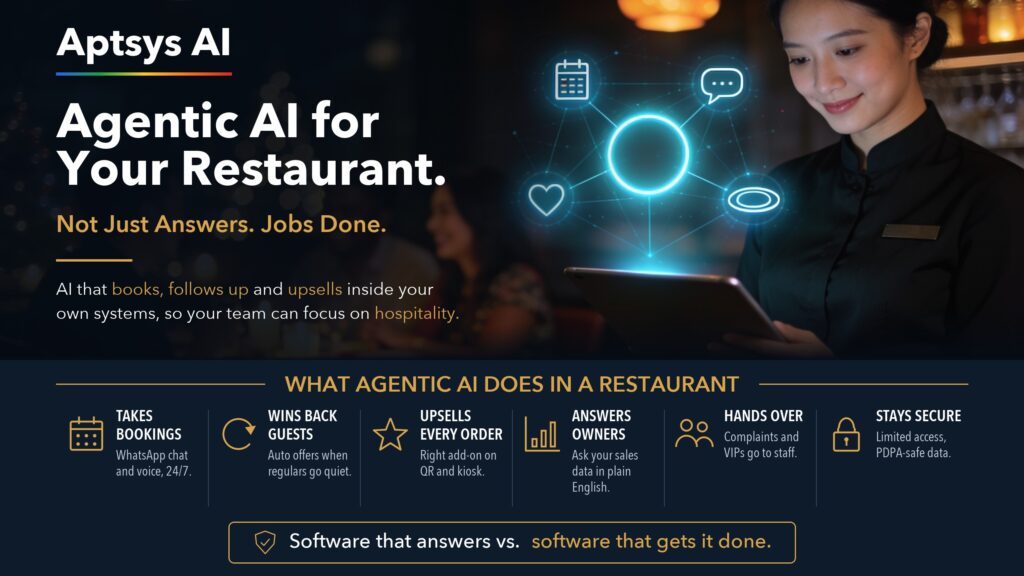
“Agentic AI” is the new phrase in every tech pitch, and most Singapore F&B owners have already heard it from a vendor this year. Most of them were never told what it means. For a restaurant, agentic AI is software that doesn’t just answer a question. It completes a task from start to finish, inside your own systems, within rules you set.
That difference matters more than the label. Here’s what agentic AI for a Singapore restaurant looks like in practice, where it helps, and how to tell whether a vendor is selling the real thing.
What agentic AI means for a restaurant, in plain terms
Compare three levels:
- A chatbot answers. A guest asks, “Are you open on Christmas Day?” and it replies. Then a human still has to do the work.
- An automation follows a fixed script. “Send a birthday voucher 7 days before the date.” It’s useful, but it can’t handle anything outside the script.
- An agent completes the job. A guest messages, “Table for 6 this Saturday, around 7?” The agent checks availability, offers 7:30pm because 7pm is full, confirms the booking, puts it into your reservation system and sends a reminder the day before. Nobody on your team touched it.
The test is simple: does the AI finish the task, or does it hand the task back to your staff?
Where agentic AI already works in Singapore restaurants
Reservations on WhatsApp and phone
This is the clearest example today. Singapore diners prefer to book on WhatsApp, and an AI booking agent can reply to every message 24/7, answer voice calls, take the booking, write it into your system and send reminders. Bookwise does this across web, chat bot, WhatsApp chat and WhatsApp voice calls, so the floor team stops typing “can, what time?” during dinner service.
Customer follow-up through your CRM
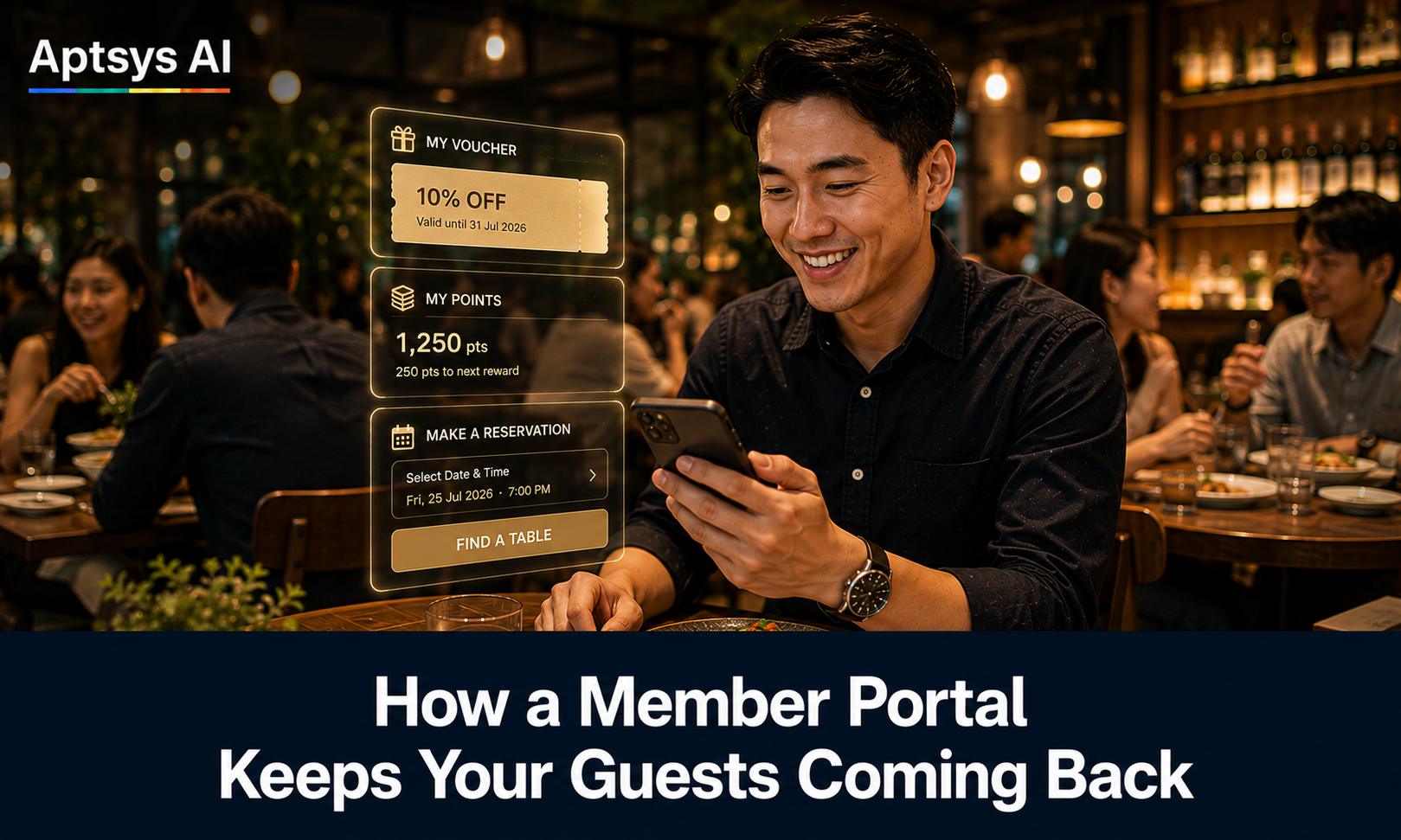
An agentic CRM doesn’t just store member data. When a regular hasn’t visited for, say, 60 days, the Aptsys CRM automatically sends a win-back offer, then matches the member’s return visit at the POS so you can see which offers actually brought people back. Birthday, lapsed-member and spend-tier campaigns run in the background without a manager exporting lists. See our guide to running promotions through your restaurant CRM.
Ordering and upselling on QR and kiosk
When guests order on QR ordering or a kiosk, AI can suggest the right add-on for each order, every time, not just when a cashier remembers. It’s a small agent with one job, done consistently through the whole service.
Asking your sales data a question
The next step is AI that works for the owner, not just the guest. Aptsys connects your POS data to AI assistants, so you can ask in plain English, “What were my top sellers last Friday?” or “Where are my voids and discounts coming from?”, and get an answer from your live sales data instead of digging through reports.
Where agentic AI still needs your people
An agent is only as good as the rules and data you give it. Keep a human in the loop for:
- Refunds, complaints and VIP guests. The agent should hand these over, not improvise.
- Exceptions. For a 40-pax booking with a deposit, or a guest with a severe allergy, the AI collects the details and staff make the decision.
- Anything that changes money or menus. Price changes, voids and discounts should still need a person’s approval.
As we wrote in Will AI Replace Restaurant Staff in Singapore?, the goal isn’t fewer people. It’s your people doing hospitality instead of admin.
The risks of agentic AI in a restaurant
An AI that can act inside your systems needs the same care as a new staff member with system access:
- Limited permissions. It should only touch what it needs, such as bookings and messages, not your full sales data or payment settings.
- Customer data. Guest names, phone numbers and birthdays fall under the PDPA. Know where the data is stored and who can see it.
- Security. CSA has warned that cyber incidents in Singapore have tripled since September. An AI connected to your systems is one more door to lock.
3 questions to test any agentic AI pitch
- “Show me a task it finishes end to end without my staff.” If every example ends with “and then your team follows up”, it’s a chatbot.
- “Which of my systems does it write into?” A real agent updates your bookings, CRM or POS. An AI that only produces suggestions in a separate app is a dashboard.
- “What happens when it doesn’t know?” It should hand over to a person cleanly and tell you it did. Guessing is not an answer.
Agentic AI for your restaurant with Aptsys
Aptsys builds AI into the systems you already run. Bookwise takes reservations on WhatsApp chat and voice. The CRM runs win-back, birthday and tier campaigns on its own and tracks who returns. QR ordering and kiosks upsell on every order, and owners can ask their sales data questions in plain English. Because POS, CRM, QR and reservations are one connected platform, the AI completes the task instead of passing it to someone to re-key.
Agentic AI isn’t magic, and it isn’t just a buzzword. In a restaurant, it’s the difference between software that answers and software that gets the job done.
See how Bookwise works → · Explore the Aptsys CRM → or book a demo with Aptsys