You ran a membership sign-up promotion. Fifty customers joined. Three months later, you’re looking at the numbers and most of them haven’t been back. The loyalty programme is technically running — but it’s not doing what it’s supposed to do.
This is one of the most common problems with restaurant loyalty programmes in Singapore: members sign up, then disappear. Not because they stopped liking your food, but because they forgot they were members. They have no idea how many points they have, what they can redeem, or why coming back is worth it. Out of sight, out of mind.
A member portal fixes this. Here’s what it is and why it changes the outcome.
What Is a Member Portal for a Restaurant?
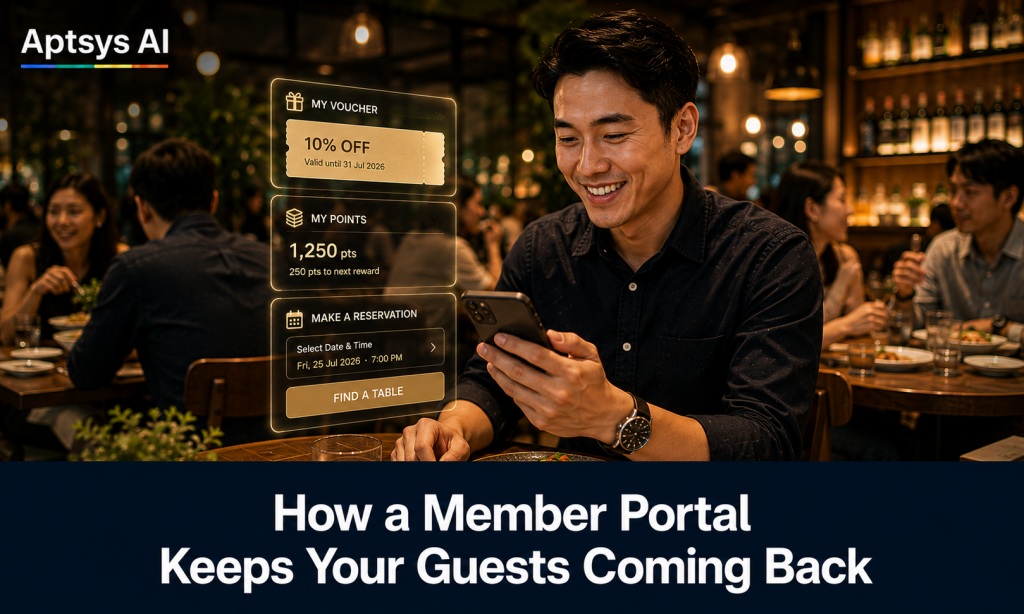
A member portal is a self-serve interface — accessible by phone via a link or QR code, no app download required — where your customers can log in and see everything about their membership in one place.
That includes their current points balance, their membership tier, what rewards they’re eligible to redeem, how far away they are from the next tier, their visit history, and any ongoing promotions or birthday perks tied to their account.
For a Singapore restaurant, that might look like this: a customer scans a QR code at your table, logs into their profile, and sees they have 480 points — 20 away from a free dessert. That visibility alone changes their behaviour. They know exactly what they’re working towards and they have a concrete reason to come back.
Without a portal, that same customer leaves the meal with no idea what their balance is. They meant to check the SMS you sent three weeks ago but never did. The next time they’re choosing where to have lunch, your restaurant doesn’t come to mind.
Why Visibility Is the Engine of Loyalty
The mechanics of a loyalty programme — points, tiers, rewards — only work if the customer can see them. Visibility creates the emotional pull that drives return visits.
When members can check their balance at any time, a few things happen. They become more aware of how often they visit. They start tracking progress towards a reward, which gives each visit a secondary goal beyond the meal. And when they get close to a milestone — a free item, a tier upgrade, a birthday reward — they’re motivated to come back sooner to unlock it.
This is the same psychology behind every effective loyalty system, from airline miles to coffee stamp cards. The difference is that a well-built member portal makes it frictionless and always accessible, which is what Singapore customers now expect.
What a Good Member Portal Includes
Not all member portals are built the same. The ones that actually drive return visits have a few things in common.
A live, up-to-date points balance. Not “your balance as of last week’s sync” — the actual balance after every transaction. If a customer orders lunch and checks their portal that afternoon, the new points should be there.
Clear reward visibility. Customers should be able to see exactly what they can redeem, what it costs in points, and how to use it on their next visit. Ambiguity kills redemption rates.
Tier status and progress. If your programme has tiers — standard, silver, gold — members should be able to see where they are and what the next tier unlocks. Progress bars work well here.
Birthday and personalised perks. A portal that surfaces a birthday reward a week before the customer’s birthday, and tells them it expires, creates urgency that a generic email blast never will.
Visit history. Simple but effective. Customers who can see their own history with your restaurant feel a stronger connection to it. It makes the relationship feel real.
How It Works in a Singapore Restaurant Context
The setup is simpler than most owners expect. Your POS and CRM handle the backend — every transaction is recorded, points are calculated automatically, and member profiles are updated in real time. The portal is the front-end layer that gives customers access to their own data.
Staff don’t need to explain the programme to every table. Customers who want to check their balance do it themselves. Redemptions are handled at the point of payment — the customer says they want to redeem, staff verify on the POS, and the transaction is settled.
For a casual dining restaurant or café in Singapore, this removes a constant source of front-of-house friction while making the loyalty programme feel more premium than it costs to run.
The Bottom Line
A member portal doesn’t replace the loyalty programme — it makes the loyalty programme work. Members who can see their balance, track their progress, and access their rewards are members who come back. Those who can’t, don’t.
If you’re running a loyalty programme and your repeat visit rate isn’t where it should be, the programme probably isn’t broken. The members just can’t see it.
Learn how Aptsys CRM and member portal works for Singapore restaurants at aptsys.com.sg/fb-crm-loyalty-programme-singapore-aptsys/.