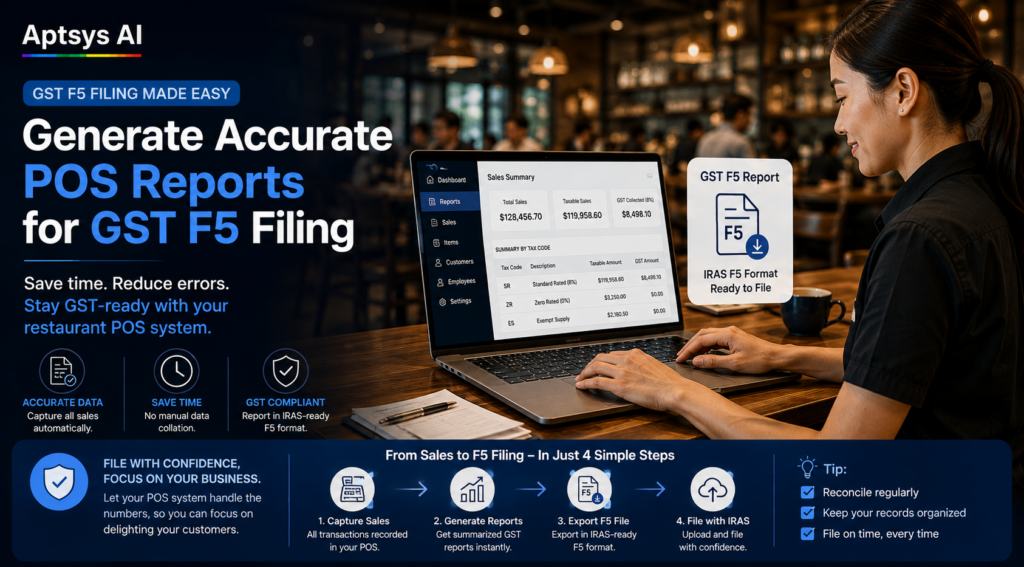
If your restaurant files GST quarterly, your GST F5 return for July to September is due on 31 October. For many Singapore F&B operators, GST F5 filing means a week of exporting sales reports, fixing spreadsheets and chasing outlet managers for missing numbers.
It should not take that long. A good POS already holds almost everything the F5 asks for. If yours does not, that is a sign worth paying attention to.
What the GST F5 return actually asks for
The F5 is a summary of the quarter. For a typical restaurant, the figures that matter are:
- Standard-rated supplies — your taxable sales, before GST.
- Zero-rated and exempt supplies — usually small or nil for a dine-in restaurant.
- Output tax due — the GST you collected from customers at 9%.
- Taxable purchases and input tax claimed — the GST you paid on ingredients, rent and equipment.
The sales side comes from your POS. The purchases side comes from your accounting system. Problems almost always start on the sales side.
The POS reports your GST F5 filing depends on
1. Net sales with GST separated. Your POS should show sales excluding GST and the GST amount as separate lines. If it only gives you a GST-inclusive total, someone is back-calculating by hand.
2. Service charge, taxed correctly. Service charge is part of the taxable value of your supply, so GST applies to it. Your POS should calculate GST on food plus service charge, and report both clearly.
3. Discounts, voids and refunds already netted. Member discounts, staff meals, voided items and refunds all change the taxable amount. A report that shows gross sales and leaves you to subtract the rest is an invitation to mistakes.
4. Stored value and vouchers handled separately. This is where many restaurants get caught. A customer topping up a stored value card has not bought a meal yet. Under IRAS rules for face-value vouchers, GST is generally accounted for when the value is redeemed, not when it is sold. Keep top-ups and redemptions separate, so they are not double-counted as sales.
5. Every outlet on the same system. One GST-registered company files one F5, however many outlets it runs. If every outlet runs the same POS, each outlet’s report comes out in the same format and the totals add up cleanly. Mixed systems mean mixed report formats — and mistakes when you combine them.
Red flags that your POS is making GST filing harder
- You export daily Z-reports and add them up manually for the quarter.
- Your total GST does not match total sales multiplied by 9/109, and nobody knows why.
- Refunds are recorded on paper and adjusted at quarter end.
- Stored value top-ups show up inside your sales total.
- Each outlet runs a different system, or a different version of the same one.
Any one of these adds hours to every filing. All of them together add real risk. IRAS imposes a $200 penalty for a late F5, plus $200 for each completed month it stays outstanding.
A simple monthly habit that makes quarter-end painless
Do not wait for the quarter to close. Once a month, spend 20 minutes on this:
- Pull the month’s GST summary from your POS.
- Check that sales excluding GST plus GST equals your total takings.
- Review discounts, voids and refunds for anything unusual.
- Reconcile stored value top-ups and redemptions.
- Send the summary to your accountant or bookkeeper.
By the end of the quarter, three months are already checked. Filing becomes a matter of adding them up.
How Jade POS supports GST F5 filing
With Jade POS, the GST work is already done at the till. Every sale is recorded with its GST in GEMSCMS, the Jade back office, which produces a monthly Tax report showing the total GST collected. The report runs per outlet, per month. At quarter end, pull the Tax report for each outlet for each of the three months, then add the GST totals together — that is the figure your F5 output tax starts from.
Better still, pull each outlet’s report every month as part of the monthly habit above. A three-outlet group then has three reports to check each month, not nine at quarter end. By the time the quarter closes, every month is already checked — no adding up daily Z-reports, no back-calculating 9/109 by hand.
The result: your quarterly F5 starts from monthly outlet reports you pull in minutes, not a spreadsheet you rebuild.
See what Jade POS reports for your outlet → or book a demo with Aptsys.
This article is general guidance, not tax advice. For your specific GST treatment, check with your accountant or IRAS.