If you run more than one F&B outlet in Singapore, you already know the problem. You update the price of a dish at your main branch, then spend the next hour calling or messaging your other locations to make sure they’ve done the same. Someone forgets. A customer gets charged the old price. Your accounts don’t reconcile. And the week after, you do it again.
Multi-outlet menu management is one of the most underestimated operational headaches in Singapore F&B — and the way you handle it determines how much of your time goes into admin versus running the business.
There are two main approaches. Understanding which one fits your operation is the first decision worth getting right.
What Is Centralised Menu Management?
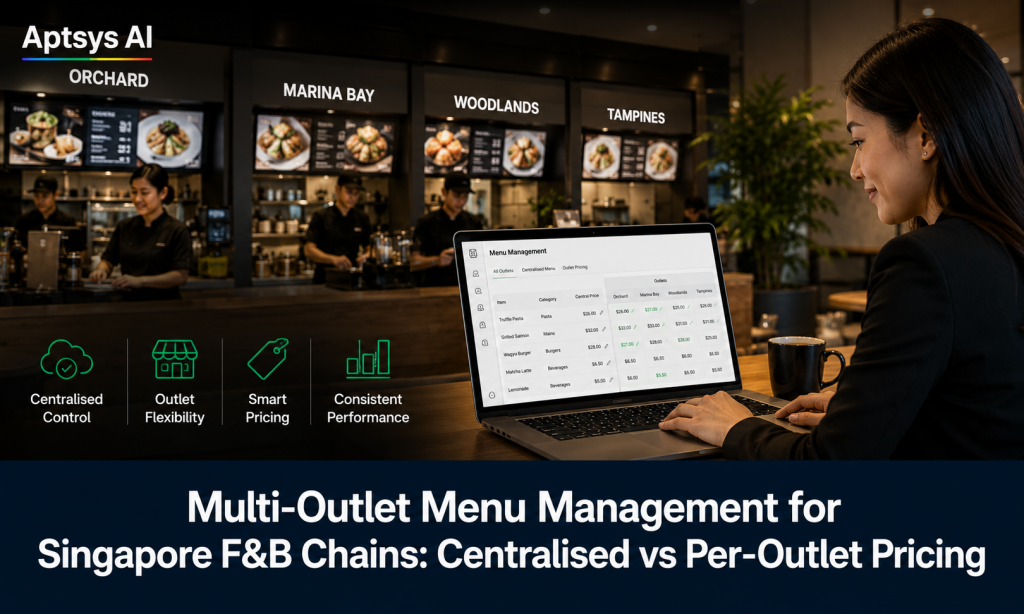
Centralised menu management means one master menu lives in your system, and any change made there is pushed automatically to every outlet. Update a price, add a new item, run a promotion — it applies everywhere, instantly, without anyone having to manually relay the instruction.
This is the model most growing F&B chains in Singapore move toward. It works especially well when:
- You operate under one brand with consistent pricing across all outlets
- You run frequent promotions that need to go live at the same time
- You have outlets in different locations managed by different staff who shouldn’t be setting their own prices
- You’re adding new outlets and need to replicate your setup quickly
The operational payoff is significant. Menu updates that used to take an hour across five locations happen in minutes. Pricing errors drop. And your reporting stays clean because every outlet is working from the same data.
When Per-Outlet Pricing Makes Sense
Per-outlet pricing lets each location manage its own menu independently — different prices, different items, different promotions.
This isn’t a workaround. For some operations, it’s the right model:
- Franchise setups, where individual franchisees have agreed pricing flexibility within a range
- Multi-concept groups, where each outlet runs a different brand with a completely different menu
- Location-specific pricing, where a CBD outlet charges more than a heartland branch to reflect rent and footfall differences
- Hawker stalls or market concepts, where each stall under a group identity operates semi-independently
The trade-off is control. Per-outlet pricing gives flexibility but creates the conditions for inconsistency — and in a tight-margin business, inconsistency is expensive.
The Real Problem: Most Singapore F&B Operators Are Doing Neither Properly
In practice, what most multi-outlet operators in Singapore actually have is a hybrid that nobody designed: one outlet updates a spreadsheet, another uses the POS backend, a third waits for the manager to come in. The result is that no single version of the menu is authoritative.
This creates downstream problems beyond just pricing. Your sales reports across outlets become hard to compare because item names and codes aren’t consistent. Your inventory counts are off. Your promotions don’t run cleanly. And when you try to scale to a fourth or fifth outlet, you’re scaling the mess.
What to Look for in a POS That Handles Multi-Outlet Management
Not every POS system is built for multi-outlet operations. When you’re evaluating options, the questions to ask are:
Can I make a menu change once and push it to all outlets immediately? Some systems require you to log in to each outlet separately. That’s not multi-outlet management — that’s just a web interface.
Can I override at the outlet level when I need to? A centralised system shouldn’t mean no flexibility. You need to be able to set outlet-specific prices for certain items without breaking the master menu for everything else.
Can I control what outlet managers can and can’t change? Staff at an individual outlet should be able to do their job without being able to accidentally alter group-wide pricing. Role-based access at the outlet level matters.
Does my reporting consolidate across outlets automatically? If you’re manually exporting and merging sales data from four locations every week, your POS isn’t doing its job.
The Bottom Line
Centralised menu management is the right default for most Singapore F&B chains. It saves time, reduces errors, and makes expansion far less painful. Per-outlet pricing is a legitimate choice — but it should be a deliberate one, not something that happens because your system can’t handle the alternative.
If you’re at the point where menu updates feel like a project rather than a routine task, the system is the problem, not the process.
Aptsys Jade POS is built for multi-outlet F&B operations in Singapore — centralised menu control, outlet-level overrides, and consolidated reporting across all your locations. See how it works →