
If your restaurant signed up with a payment provider because the rate looked unbeatable, it’s worth asking one question: do you actually know why it was so cheap? For a lot of Singapore F&B merchants, the answer traces back to a merchant category code (MCC) they never chose and probably don’t know they have — MCC 5814, “Fast Food.” And relying on a rate you don’t understand, or don’t control, is a riskier position than most operators realise.
How MCC codes quietly set your rate
Every card transaction your business processes is tagged with a four-digit merchant category code that tells the card networks what kind of business you run. That code isn’t just a label — it’s one of the main things that determines your interchange rate, the wholesale cost baked into every card transaction before your processor adds its own margin on top. Certain categories, including fast food, have historically carried a lower default rate than full-service dining under MCC 5812 (Restaurants). On paper, that sounds like a straightforward cost saving. In practice, it only holds up if your business genuinely fits the category you’ve been coded under.
Who payment facilitators are
Most Singapore F&B merchants don’t deal directly with a bank or a licensed acquirer for card processing. Instead, they sign up through a payment facilitator — a reseller that doesn’t hold its own acquiring license, but instead resells processing capacity from a licensed acquirer under a commission-based arrangement. This is an extremely common and entirely legitimate model in payments. The issue isn’t that facilitators exist; it’s how some of them are incentivised. A sales agent earning commission on sign-ups, and often a cut of ongoing processing volume, has a direct interest in quoting the lowest rate that closes the deal today.
The lever they control
MCC classification is one of the few things a facilitator actually sets during merchant onboarding. Coding a full-service restaurant, café, or bar as MCC 5814 (Fast Food) instead of MCC 5812 (Restaurants) can produce a materially lower headline rate — one that looks great in a sales pitch, regardless of whether the business is, in any meaningful sense, a fast food operation.
Why merchants go along with it
This classification decision happens on the back end during account setup — it isn’t something most merchants review, question, or approve line by line, and plenty genuinely don’t know their account is coded this way until something flags it, like a bank rewards or cashback exclusion, or a new hire in finance querying a statement.
But a fair number of operators do know, or at least suspect it, and go along with it anyway. If the classification is quietly delivering a lower rate, the incentive to ask questions is weak — why query something that’s saving you money? The risk either way is the same: this rate was never something the merchant negotiated or is entitled to keep. It exists because of a classification decision made on someone else’s back end, for someone else’s commercial reasons, and it can be revisited at any time without the merchant having any say in it.
Why this is risky now
A rate tied to a classification you don’t control, and may not even qualify for, was never something you could rely on long term. If that classification comes under closer scrutiny — whether from the card networks tightening enforcement or your acquirer reviewing merchant accounts — the low rate can disappear as fast as it appeared, and you’ll be left absorbing a cost increase you never saw coming, because you never understood why the rate was low in the first place.
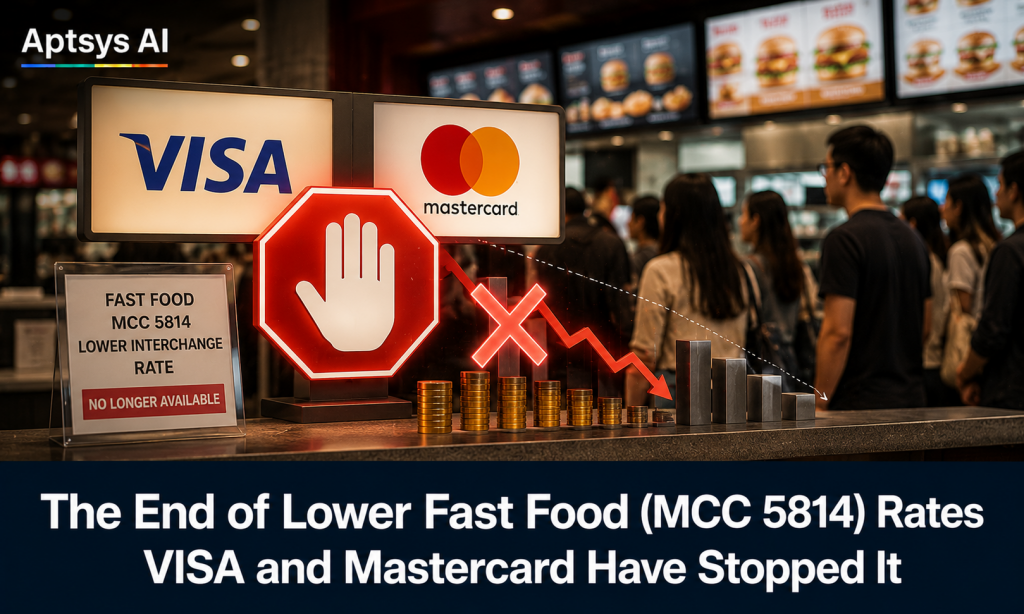
This isn’t just a hypothetical risk. Industry reports indicate that starting 1 September 2026, fast food and quick service restaurants in Singapore coded under MCC 5814 will lose the discount they’ve had on card processing fees. Visa and Mastercard currently charge these businesses less than other restaurants to accept card payments — but according to these reports, both networks are ending that discount from that date, meaning fast food outlets would start paying the same standard card fees as everyone else. We haven’t been able to independently confirm this directly with Visa or Mastercard, so treat it as an industry signal rather than settled fact — but it’s exactly the kind of change that would catch a merchant off guard if they don’t already know what MCC they’re on.
Staying with the facilitator that set up this classification doesn’t fix the underlying problem — it just leaves you waiting for the next surprise.
A broker works differently — and that’s the fix
This is where the distinction between a payment facilitator and a payment broker matters. Wallet.com.sg, a sister company of Aptsys, operates purely as a broker: it doesn’t own a gateway, and it doesn’t earn its margin from how your business is classified. Its role is to shop your transaction volume across a network of payment gateways and find the lowest genuine MDR your business actually qualifies for, based on what your business really is, not on whichever category produces the best headline number for a sales pitch.
Because Wallet has no stake in keeping you with any single gateway, there’s no incentive to misclassify you, and no incentive to keep you locked into a facilitator relationship that isn’t working in your favour.
If you suspect your business has been coded as fast food when it shouldn’t be, or you’re simply not sure what MCC you’re actually on, contact Wallet. They’ll review your current classification and rate, and where a facilitator has you locked into an unfavourable or inaccurate setup, help you move off it entirely and onto a gateway that reflects what your business actually does — at a rate you can rely on. Get in touch with Wallet to have your account reviewed.
How Aptsys is different
Jade POS integrates payments — NETS, PayNow, and card — directly into your point-of-sale system, with transaction-level reporting you can see and act on. Paired with Wallet’s broker model on the rate side, you get both a clear view of what you’re actually being charged and a way to fix it if the number doesn’t add up. Get a free demo to see how Jade POS gives you a clear, transparent view of your true cost of accepting payments.