If your kitchen still runs on printed dockets or handwritten tickets, you already know the pain: lost orders, shouted clarifications, meals going cold while waiting on a missing item. A kitchen display system (KDS) solves all of this — and for many Singapore restaurants, it is one of the highest-impact tech investments they can make. Here is what a KDS is, how it works, and how to know if your restaurant needs one.
What Is a Kitchen Display System?
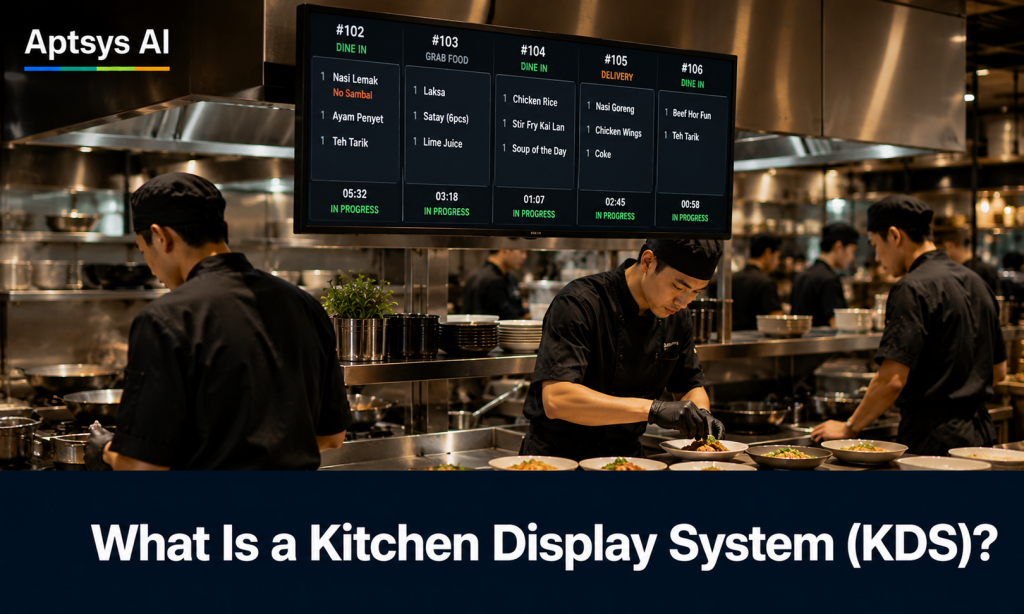
A kitchen display system is a digital screen mounted in your kitchen that shows incoming orders in real time, directly from your POS, QR ordering system, or online ordering platform. Instead of printing a paper docket or relying on a server to shout an order through a hatch, orders appear on screen the moment they are placed — colour-coded, timed, and organised by station.
Each order shows:
- The items ordered and any special requests
- The table number or order reference
- A timer showing how long the order has been waiting
- Status indicators (new, in progress, ready)
Kitchen staff can mark items as done with a tap, and the system can alert the floor team the moment food is ready for collection.
How Is a KDS Different from a Kitchen Printer?
Kitchen printers have been the standard for decades, but they have real limitations:
| Kitchen Printer | KDS | |
|---|---|---|
| Paper waste | High | None |
| Order modifications | New ticket printed, old one still floating | Updates in real time on screen |
| Speed visibility | None | Timer per order |
| Multi-station routing | Manual sorting | Automatic by station |
| Void/cancel orders | Confusing, paper stays** | Removed instantly from screen |
The core difference: a KDS is live and connected. A printer is one-way and static.
What Problems Does a KDS Solve?
Lost and missed orders
Paper dockets get wet, fall off the pass, or get buried under other tickets. A KDS keeps every order visible and accounted for until it is marked complete.
Order modifications not reaching the kitchen
When a customer changes an order after it has been placed, that update appears instantly on the KDS. No second trip to the kitchen, no wrong dish going out.
Slow ticket times during peak hours
The timer on each order creates natural accountability. Kitchen staff can see at a glance which orders are running long — before a customer complains. Managers can review historical ticket times to identify bottlenecks.
Multi-station coordination
For restaurants with separate stations — grill, fryer, salad, drinks — a KDS can route each item to the right screen automatically. The pass screen shows when all components of an order are ready, so nothing sits waiting on a cold chip.
Do You Need a KDS? Ask These Questions
Do you lose or misplace paper dockets during service? If yes, a KDS eliminates this entirely.
Do your kitchen staff regularly need to clarify orders with floor staff? A KDS with special request visibility reduces this significantly.
Are you struggling to track ticket times or kitchen speed? KDS reporting gives you average prep times by dish, by station, and by time period.
Do you run QR ordering or online orders alongside dine-in? Without a KDS, orders from multiple channels can create chaos in the kitchen. A KDS consolidates everything into one screen.
Do you have more than one kitchen station? Single-station operations (a hawker stall with one cook, for example) may not need a KDS. But any kitchen with two or more stations that need to coordinate will benefit.
What About Smaller Restaurants or Cafés?
A KDS is not just for large operations. Many Singapore cafés with just 3–4 kitchen staff have adopted KDS and found it particularly useful during weekend peak hours when a handful of simultaneous orders can overwhelm paper systems.
The setup is also simpler than most owners expect: a screen mounted in the kitchen, connected to your existing POS or ordering system. No major renovation required.
Ready to See a KDS in Action?
A kitchen display system is one of those tools that kitchen staff adopt immediately — because it makes their job measurably easier from day one. If your kitchen runs on paper dockets and you have ever had a lost order during service, it is worth a serious look.